

Fertility Services Market Size to Hit USD 150.2 Billion by 2034 | With a 12.15% CAGR
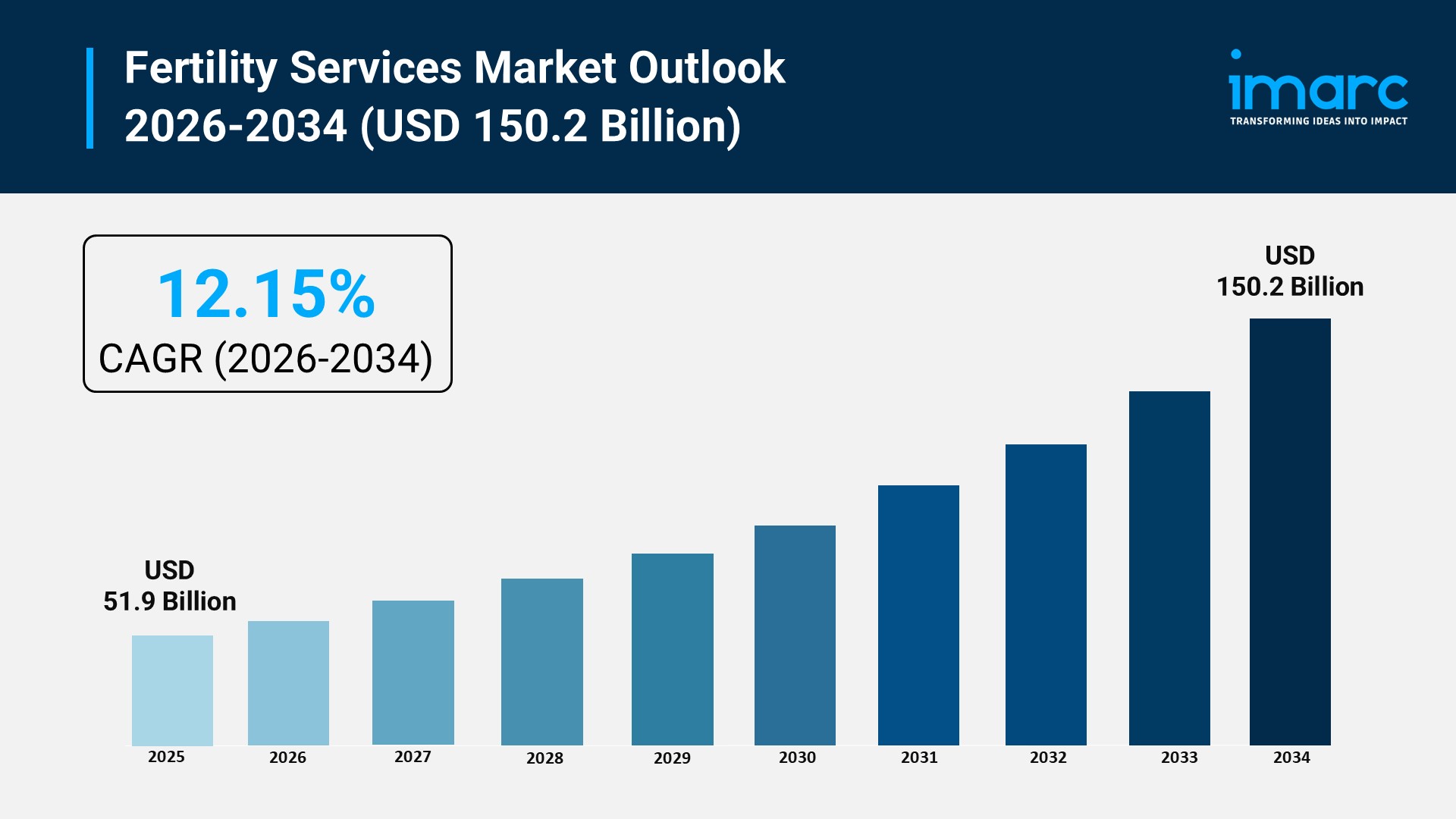
Fertility services market is growing rapidly due to rising infertility & delayed parenthood, reaching USD 150.2B by 2034 from USD 51.9B in 2025 at 12.15% CAGR.
SHERDIAN, WY, UNITED STATES, March 27, 2026 /EINPresswire.com/ -- 𝐌𝐚𝐫𝐤𝐞𝐭 𝐎𝐯𝐞𝐫𝐯𝐢𝐞𝐰:The fertility services market is experiencing rapid growth, driven by increasing prevalence of infertility and delayed parenthood, corporate integration of fertility benefits, and government initiatives and regulatory support. According to IMARC Group's latest research publication, "𝐅𝐞𝐫𝐭𝐢𝐥𝐢𝐭𝐲 𝐒𝐞𝐫𝐯𝐢𝐜𝐞𝐬 𝐌𝐚𝐫𝐤𝐞𝐭 𝐒𝐢𝐳𝐞, 𝐒𝐡𝐚𝐫𝐞, 𝐓𝐫𝐞𝐧𝐝𝐬 𝐚𝐧𝐝 𝐅𝐨𝐫𝐞𝐜𝐚𝐬𝐭 𝐛𝐲 𝐂𝐚𝐮𝐬𝐞 𝐨𝐟 𝐈𝐧𝐟𝐞𝐫𝐭𝐢𝐥𝐢𝐭𝐲, 𝐏𝐫𝐨𝐜𝐞𝐝𝐮𝐫𝐞, 𝐒𝐞𝐫𝐯𝐢𝐜𝐞, 𝐄𝐧𝐝-𝐔𝐬𝐞𝐫, 𝐚𝐧𝐝 𝐑𝐞𝐠𝐢𝐨𝐧, 𝟐𝟎𝟐𝟔-𝟐𝟎𝟑𝟒", the global fertility services market size was valued at 𝐔𝐒𝐃 𝟓𝟏.𝟗 𝐁𝐢𝐥𝐥𝐢𝐨𝐧 in 2025. Looking forward, IMARC Group estimates the market to reach 𝐔𝐒𝐃 𝟏𝟓𝟎.𝟐 𝐁𝐢𝐥𝐥𝐢𝐨𝐧 by 2034, exhibiting a 𝐂𝐀𝐆𝐑 𝐨𝐟 𝟏𝟐.𝟏𝟓% from 2026-2034.
This detailed analysis primarily encompasses industry size, business trends, market share, key growth factors, and regional forecasts. The report offers a comprehensive overview and integrates research findings, market assessments, and data from different sources. It also includes pivotal market dynamics like drivers and challenges, while also highlighting growth opportunities, financial insights, technological improvements, emerging trends, and innovations. Besides this, the report provides regional market evaluation, along with a competitive landscape analysis.
𝐃𝐨𝐰𝐧𝐥𝐨𝐚𝐝 𝐚 𝐬𝐚𝐦𝐩𝐥𝐞 𝐏𝐃𝐅 𝐨𝐟 𝐭𝐡𝐢𝐬 𝐫𝐞𝐩𝐨𝐫𝐭: https://www.imarcgroup.com/fertility-services-market/requestsample
𝐎𝐮𝐫 𝐫𝐞𝐩𝐨𝐫𝐭 𝐢𝐧𝐜𝐥𝐮𝐝𝐞𝐬:
● Market Dynamics
● Market Trends and Market Outlook
● Competitive Analysis
● Industry Segmentation
● Strategic Recommendations
𝐆𝐫𝐨𝐰𝐭𝐡 𝐅𝐚𝐜𝐭𝐨𝐫𝐬 𝐢𝐧 𝐭𝐡𝐞 𝐅𝐞𝐫𝐭𝐢𝐥𝐢𝐭𝐲 𝐒𝐞𝐫𝐯𝐢𝐜𝐞𝐬 𝐌𝐚𝐫𝐤𝐞𝐭
● 𝐈𝐧𝐜𝐫𝐞𝐚𝐬𝐢𝐧𝐠 𝐏𝐫𝐞𝐯𝐚𝐥𝐞𝐧𝐜𝐞 𝐨𝐟 𝐈𝐧𝐟𝐞𝐫𝐭𝐢𝐥𝐢𝐭𝐲 𝐚𝐧𝐝 𝐃𝐞𝐥𝐚𝐲𝐞𝐝 𝐏𝐚𝐫𝐞𝐧𝐭𝐡𝐨𝐨𝐝
The global expansion of the fertility services market is primarily fueled by a significant rise in infertility rates, which now affect approximately one in six people of reproductive age worldwide according to the World Health Organization. This shift is largely attributed to the growing societal trend of delayed parenthood, as many individuals prioritize career advancement and financial stability before starting a family. Biological challenges naturally increase with age; for instance, clinical data indicates that while women under 35 experience in vitro fertilization success rates between 50% and 60%, these figures drop to approximately 10% to 20% for those over the age of 40. Consequently, the demand for medical intervention has intensified, with nearly 27.5 million couples in India alone currently facing infertility challenges. This demographic evolution ensures a steady and growing patient base seeking assisted reproductive technologies to overcome age-related or lifestyle-induced reproductive hurdles in both developed and emerging economies.
● 𝐂𝐨𝐫𝐩𝐨𝐫𝐚𝐭𝐞 𝐈𝐧𝐭𝐞𝐠𝐫𝐚𝐭𝐢𝐨𝐧 𝐨𝐟 𝐅𝐞𝐫𝐭𝐢𝐥𝐢𝐭𝐲 𝐁𝐞𝐧𝐞𝐟𝐢𝐭𝐬
A transformative driver in the fertility sector is the rapid adoption of reproductive health coverage within corporate benefit packages. Leading employers are increasingly recognizing fertility support as a vital tool for talent recruitment and retention, particularly among younger generations who value family-building autonomy. In the United States, more than 450 of the Fortune 500 companies now provide some form of fertility benefit, a movement that has empowered over 12 million employees with managed access to specialized care. Managed benefit platforms like Progyny and Carrot Fertility have seen explosive growth, with some providers serving more than 460 large employer clients as of recent reports. These corporate initiatives effectively transition fertility treatments from a prohibitive out-of-pocket expense—often exceeding $15,000 to $20,000 per cycle—into a mainstream, accessible healthcare standard. This institutional financial support significantly lowers the barrier to entry for millions of prospective parents, directly boosting clinical volumes and service utilization.
● 𝐆𝐨𝐯𝐞𝐫𝐧𝐦𝐞𝐧𝐭 𝐈𝐧𝐢𝐭𝐢𝐚𝐭𝐢𝐯𝐞𝐬 𝐚𝐧𝐝 𝐑𝐞𝐠𝐮𝐥𝐚𝐭𝐨𝐫𝐲 𝐒𝐮𝐩𝐩𝐨𝐫𝐭
National governments and public health organizations are increasingly categorizing infertility as a critical public health priority, leading to supportive legislation and subsidized treatment programs. Many countries have expanded their public health frameworks to include fertility care, with government funding for assisted reproduction now available in over 60 nations. In India, the government has integrated maternal and reproductive healthcare as a core component of the Ayushman Bharat mission, establishing over 1.81 lakh Ayushman Arogya Mandirs to serve a population of 1.4 billion. Furthermore, new regional mandates, such as recent laws in California, require insurance providers to cover long-term gamete storage for patients undergoing cancer treatments. These legislative efforts, combined with large-scale awareness campaigns like the "Swastha Nari, Sashakt Parivaar Abhiyaan," which engaged over 11 crore women, are normalizing medical intervention. By reducing the financial burden and improving the healthcare infrastructure, these state-led activities are fostering a more inclusive and robust global market for fertility services.
𝐊𝐞𝐲 𝐓𝐫𝐞𝐧𝐝𝐬 𝐢𝐧 𝐭𝐡𝐞 𝐅𝐞𝐫𝐭𝐢𝐥𝐢𝐭𝐲 𝐒𝐞𝐫𝐯𝐢𝐜𝐞𝐬 𝐌𝐚𝐫𝐤𝐞𝐭
● 𝐀𝐈-𝐃𝐫𝐢𝐯𝐞𝐧 𝐏𝐫𝐞𝐜𝐢𝐬𝐢𝐨𝐧 𝐢𝐧 𝐄𝐦𝐛𝐫𝐲𝐨 𝐒𝐞𝐥𝐞𝐜𝐭𝐢𝐨𝐧
The integration of Artificial Intelligence is revolutionizing clinical outcomes by moving the industry toward highly personalized, data-driven reproductive medicine. Modern clinics are increasingly deploying AI-powered assessment platforms, such as the FDA-cleared CHLOE system, which utilizes machine learning to evaluate embryo morphology and development with objective precision. These algorithms analyze time-lapse imaging data—capturing developmental milestones every few minutes—to predict implantation potential far more accurately than traditional manual observation. By identifying the most viable embryos early in the process, practitioners can improve pregnancy success rates and significantly reduce the risk of multiple pregnancies. Real-world applications of this technology show that AI-assisted models can outperform standard benchmarks for outcome forecasting. This trend not only enhances the efficiency of laboratory workflows but also provides patients with evidence-based confidence, making the complex process of in vitro fertilization more predictable and successful for a wider range of candidates.
● 𝐒𝐮𝐫𝐠𝐞 𝐢𝐧 𝐒𝐨𝐜𝐢𝐚𝐥 𝐚𝐧𝐝 𝐌𝐞𝐝𝐢𝐜𝐚𝐥 𝐂𝐫𝐲𝐨𝐩𝐫𝐞𝐬𝐞𝐫𝐯𝐚𝐭𝐢𝐨𝐧
Cryopreservation, specifically egg and embryo banking, has evolved from a niche medical necessity into a mainstream proactive healthcare strategy. There is a marked shift toward "planned fertility," where individuals freeze their genetic material to preserve reproductive options for the future. In the United States, recent data shows over 141,857 egg and embryo banking cycles, reflecting a paradigm change in how individuals manage their biological clocks. Beyond social freezing, "oncofertility" has emerged as a critical non-discretionary trend, allowing cancer patients to preserve gametes before undergoing gonadotoxic treatments like chemotherapy. The technical boundaries are also expanding, with successful ovarian tissue cryopreservation now possible even in pediatric cases as young as 18 months. Specialized programs and grants, such as the $450,000 research investment from the National Institutes of Health, are further refining these techniques. This trend emphasizes a growing global commitment to reproductive autonomy and long-term family planning through advanced bio-banking infrastructure.
● 𝐄𝐱𝐩𝐚𝐧𝐬𝐢𝐨𝐧 𝐢𝐧𝐭𝐨 𝐓𝐢𝐞𝐫 𝐈𝐈 𝐚𝐧𝐝 𝐓𝐢𝐞𝐫 𝐈𝐈𝐈 𝐔𝐫𝐛𝐚𝐧 𝐇𝐮𝐛𝐬
Growth in the fertility sector is no longer confined to major metropolitan centers, as services rapidly expand into Tier II and Tier III cities to meet untapped regional demand. This geographical diversification is driven by a combination of rising disposable income in smaller urban areas and the establishment of satellite clinics by major fertility networks. In regions like India, cities such as Jamnagar, Amritsar, and Meerut are becoming new hubs for reproductive care, often offering treatment costs that are 25% to 30% lower than those in major metros. This decentralization is supported by the rise of "tele-fertility" platforms, which facilitate over 500,000 virtual consultations annually, bridging the gap between rural patients and urban specialists. By bringing advanced laboratory technologies and standardized protocols to smaller cities, the industry is effectively dismantling geographic barriers. This trend ensures that high-quality fertility care is accessible to a much broader demographic, moving beyond elite urban populations to reach millions of prospective parents in developing regions.
𝐀𝐬𝐤 𝐀𝐧𝐚𝐥𝐲𝐬𝐭 𝐨𝐟 𝐂𝐮𝐬𝐭𝐨𝐦𝐢𝐳𝐞𝐝 𝐑𝐞𝐩𝐨𝐫𝐭: https://www.imarcgroup.com/request?type=report&id=1547&flag=E
𝐋𝐞𝐚𝐝𝐢𝐧𝐠 𝐂𝐨𝐦𝐩𝐚𝐧𝐢𝐞𝐬 𝐎𝐩𝐞𝐫𝐚𝐭𝐢𝐧𝐠 𝐢𝐧 𝐭𝐡𝐞 𝐆𝐥𝐨𝐛𝐚𝐥 𝐅𝐞𝐫𝐭𝐢𝐥𝐢𝐭𝐲 𝐒𝐞𝐫𝐯𝐢𝐜𝐞𝐬 𝐈𝐧𝐝𝐮𝐬𝐭𝐫𝐲:
● Instituto Bernabéu Group
● INVO Bioscience, Inc.
● Monash IVF Group
● Apollo Hospitals Enterprise Ltd.
● CARE Fertility Group Ltd.
● Carolinas Fertility Institute
● Genea Limited
● The Cooper Companies, Inc.
● Virtus Health Group
● Vitrolife Sweden AB
● The Johns Hopkins Health System Corporation
● Medicover AB (publ)
● OvaScience, Inc.
● Progyny, Inc.
● Xytex Corporation
𝐅𝐞𝐫𝐭𝐢𝐥𝐢𝐭𝐲 𝐒𝐞𝐫𝐯𝐢𝐜𝐞𝐬 𝐌𝐚𝐫𝐤𝐞𝐭 𝐑𝐞𝐩𝐨𝐫𝐭 𝐒𝐞𝐠𝐦𝐞𝐧𝐭𝐚𝐭𝐢𝐨𝐧:
𝐁𝐲 𝐂𝐚𝐮𝐬𝐞 𝐨𝐟 𝐈𝐧𝐟𝐞𝐫𝐭𝐢𝐥𝐢𝐭𝐲:
● Male Infertility
● Female Infertility
Male infertility accounts for the majority of shares due to various factors including lifestyle habits and medical conditions requiring specialized treatments.
𝐁𝐲 𝐏𝐫𝐨𝐜𝐞𝐝𝐮𝐫𝐞:
● In Vitro Fertilization with Intracytoplasmic Sperm Injection (IVF with ICSI)
● Surrogacy
● In Vitro Fertilization Without Intracytoplasmic Sperm Injection (IVF without ICSI)
● Intrauterine Insemination (IUI)
● Others
IVF with ICSI dominates the market due to its effectiveness in treating severe male infertility and maximizing fertilization chances.
𝐁𝐲 𝐒𝐞𝐫𝐯𝐢𝐜𝐞:
● Fresh Non-Donor
● Frozen Non-Donor
● Egg and Embryo Banking
● Fresh Donor
● Frozen Donor
Frozen non-donor represents the leading segment driven by advancements in cryopreservation techniques offering higher success rates and treatment flexibility.
𝐁𝐲 𝐄𝐧𝐝-𝐔𝐬𝐞𝐫:
● Fertility Clinics
● Hospitals
● Surgical Centres
● Clinical Research Institutes
● Cryobanks
Fertility clinics exhibit clear dominance due to specialized expertise, comprehensive service offerings, and advanced technology under one roof.
𝐑𝐞𝐠𝐢𝐨𝐧𝐚𝐥 𝐈𝐧𝐬𝐢𝐠𝐡𝐭𝐬:
● Asia Pacific (China, Japan, India, South Korea, Australia, Indonesia, Others)
● Europe (Germany, France, United Kingdom, Italy, Spain, Russia, Others)
● North America (United States, Canada)
● Latin America (Brazil, Mexico, Others)
● Middle East and Africa
Asia Pacific leads the market owing to large population bases, changing lifestyles, rising infertility rates, and increasing government support for fertility treatments.
𝐎𝐭𝐡𝐞𝐫 𝐓𝐫𝐞𝐧𝐝𝐢𝐧𝐠 𝐑𝐞𝐩𝐨𝐫𝐭𝐬 𝐁𝐲 𝐈𝐌𝐀𝐑𝐂 𝐆𝐫𝐨𝐮𝐩:
Crane Market Research Report
Family Offices Market Research Report
𝐄-𝐁𝐢𝐤𝐞 𝐌𝐚𝐫𝐤𝐞𝐭: https://www.imarcgroup.com/e-bike-market
𝐆𝐥𝐨𝐛𝐚𝐥 𝐒𝐞𝐞𝐝𝐬 𝐌𝐚𝐫𝐤𝐞𝐭: https://www.imarcgroup.com/prefeasibility-report-seed-processing-plant
𝐋𝐮𝐱𝐮𝐫𝐲 𝐆𝐨𝐨𝐝𝐬 𝐌𝐚𝐫𝐤𝐞𝐭: https://www.imarcgroup.com/luxury-goods-market
𝐍𝐨𝐭𝐞: 𝐈𝐟 𝐲𝐨𝐮 𝐫𝐞𝐪𝐮𝐢𝐫𝐞 𝐬𝐩𝐞𝐜𝐢𝐟𝐢𝐜 𝐝𝐞𝐭𝐚𝐢𝐥𝐬, 𝐝𝐚𝐭𝐚, 𝐨𝐫 𝐢𝐧𝐬𝐢𝐠𝐡𝐭𝐬 𝐭𝐡𝐚𝐭 𝐚𝐫𝐞 𝐧𝐨𝐭 𝐜𝐮𝐫𝐫𝐞𝐧𝐭𝐥𝐲 𝐢𝐧𝐜𝐥𝐮𝐝𝐞𝐝 𝐢𝐧 𝐭𝐡𝐞 𝐬𝐜𝐨𝐩𝐞 𝐨𝐟 𝐭𝐡𝐢𝐬 𝐫𝐞𝐩𝐨𝐫𝐭, 𝐰𝐞 𝐚𝐫𝐞 𝐡𝐚𝐩𝐩𝐲 𝐭𝐨 𝐚𝐜𝐜𝐨𝐦𝐦𝐨𝐝𝐚𝐭𝐞 𝐲𝐨𝐮𝐫 𝐫𝐞𝐪𝐮𝐞𝐬𝐭. 𝐀𝐬 𝐩𝐚𝐫𝐭 𝐨𝐟 𝐨𝐮𝐫 𝐜𝐮𝐬𝐭𝐨𝐦𝐢𝐳𝐚𝐭𝐢𝐨𝐧 𝐬𝐞𝐫𝐯𝐢𝐜𝐞, 𝐰𝐞 𝐰𝐢𝐥𝐥 𝐠𝐚𝐭𝐡𝐞𝐫 𝐚𝐧𝐝 𝐩𝐫𝐨𝐯𝐢𝐝𝐞 𝐭𝐡𝐞 𝐚𝐝𝐝𝐢𝐭𝐢𝐨𝐧𝐚𝐥 𝐢𝐧𝐟𝐨𝐫𝐦𝐚𝐭𝐢𝐨𝐧 𝐲𝐨𝐮 𝐧𝐞𝐞𝐝, 𝐭𝐚𝐢𝐥𝐨𝐫𝐞𝐝 𝐭𝐨 𝐲𝐨𝐮𝐫 𝐬𝐩𝐞𝐜𝐢𝐟𝐢𝐜 𝐫𝐞𝐪𝐮𝐢𝐫𝐞𝐦𝐞𝐧𝐭𝐬. 𝐏𝐥𝐞𝐚𝐬𝐞 𝐥𝐞𝐭 𝐮𝐬 𝐤𝐧𝐨𝐰 𝐲𝐨𝐮𝐫 𝐞𝐱𝐚𝐜𝐭 𝐧𝐞𝐞𝐝𝐬, 𝐚𝐧𝐝 𝐰𝐞 𝐰𝐢𝐥𝐥 𝐞𝐧𝐬𝐮𝐫𝐞 𝐭𝐡𝐞 𝐫𝐞𝐩𝐨𝐫𝐭 𝐢𝐬 𝐮𝐩𝐝𝐚𝐭𝐞𝐝 𝐚𝐜𝐜𝐨𝐫𝐝𝐢𝐧𝐠𝐥𝐲 𝐭𝐨 𝐦𝐞𝐞𝐭 𝐲𝐨𝐮𝐫 𝐞𝐱𝐩𝐞𝐜𝐭𝐚𝐭𝐢𝐨𝐧𝐬.
𝐀𝐛𝐨𝐮𝐭 𝐔𝐬:
IMARC Group is a global management consulting firm that helps the world’s most ambitious changemakers to create a lasting impact. The company provide a comprehensive suite of market entry and expansion services. IMARC offerings include thorough market assessment, feasibility studies, company incorporation assistance, factory setup support, regulatory approvals and licensing navigation, branding, marketing and sales strategies, competitive landscape and benchmarking analyses, pricing and cost research, and procurement research.
Elena Anderson
IMARC Services Private Limited
201-971-6302
email us here
Legal Disclaimer:
EIN Presswire provides this news content "as is" without warranty of any kind. We do not accept any responsibility or liability for the accuracy, content, images, videos, licenses, completeness, legality, or reliability of the information contained in this article. If you have any complaints or copyright issues related to this article, kindly contact the author above.
